You might assume sofa shopping is simple until you measure your doorway and realize dimensions matter more than style. A standard sofa spans 84 inches, though you’ll find common variations from 78 to 90 inches depending on manufacturer and upholstery type.
This length accommodates three average adults, but arm thickness and cushion depth can reduce usable seating space substantially. Before you commit, you’ll need to verify your room’s proportions, your door frame’s clearance, and whether casters or removable legs can ease delivery.
The wrong choice leaves you with an expensive obstacle, so precise measurement precedes every sound recommendation.
Why 84 Inches Became the Standard Sofa Length
When you’re shopping for a sofa, you’ll notice that 84 inches keeps showing up as the go-to length, and that’s no accident. This sofa length became the standard size because it hits a practical middle ground, fitting most living room layouts without overwhelming your space.
You’ll find that an 84-inch standard sofa typically seats three people comfortably, offering roughly 24 to 30 inches of seat width per person. Standard couch dimensions cluster around 78 to 90 inches, so 84 inches sits right in that sweet spot manufacturers favor.
Before you buy, measure your room carefully, accounting for sofa depth, which usually runs 30 to 40 inches, and height near 30 to 36 inches. Designers prefer this predictability; it simplifies production, helps you compare upholstery options and casters, and ensures the piece works across diverse floor plans.
What Sofa Length Fits Your Room? The Two-Thirds Rule
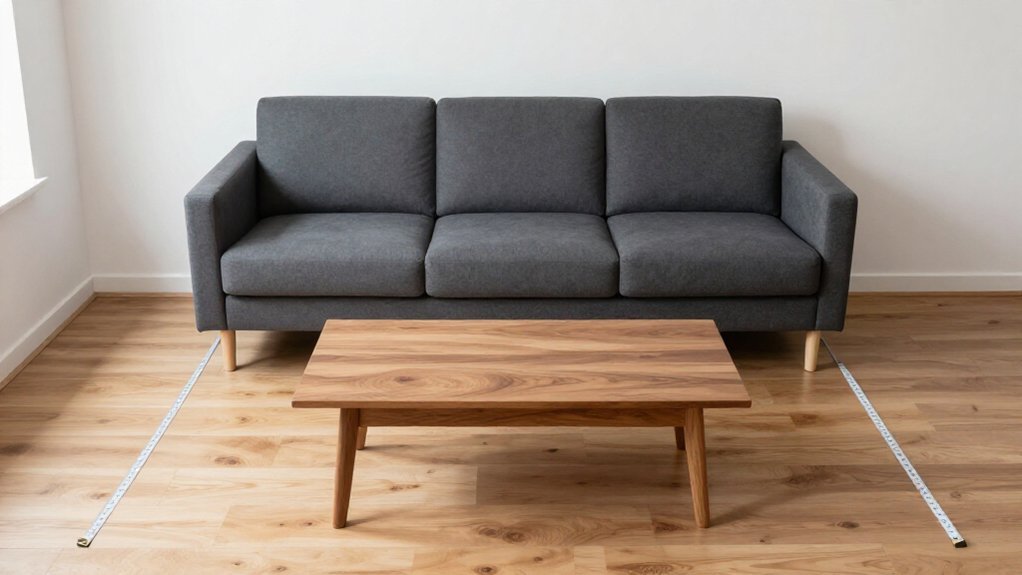
Although you’ve likely measured your wall before browsing upholstery samples, you may not have considered the two-thirds rule, a straightforward guideline that helps you avoid a sofa that dominates or disappears in your space. Apply the two-thirds rule by choosing a sofa length that fills roughly two-thirds of your wall width. For a 12-foot wall, that’s about 96 inches, so a 90 to 96 inch sofa fits well.
Standard sofa length, typically 84 to 90 inches, often suits moderate living space. In smaller spaces, select 70 to 78 inches to maintain proportion without crowding. Always verify walkway clearance of 30 to 36 inches around your seating. Match your room size to these proportions, and you’ll balance visual harmony with practical circulation.
Why “3-Seat” Sofas Often Seat Two People
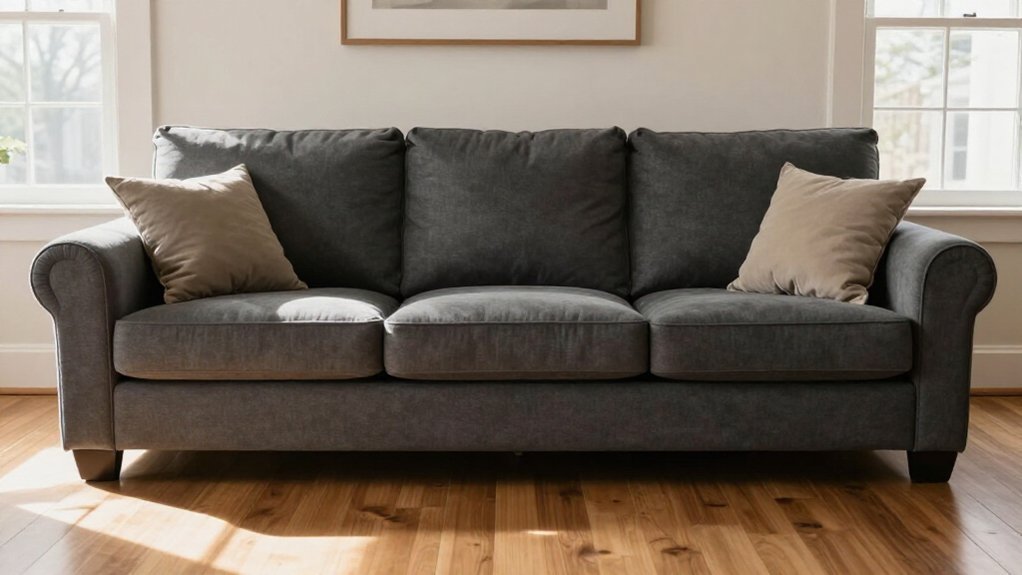
Open a furniture website, and you’ll notice most sofas carry a “3-seat” label, but that number rarely matches real-world comfort. You will find that standard sofa sizes and dimensions often mislead you about actual seating capacity.
A three-seater sofa’s wide arms and frame steal usable width, leaving only 24–30 inches per person. Standard 84–90 inch widths shrink somewhat when you subtract 4–8 inch arms from each side. Manufacturers use “3-seat” as marketing, assuming one spot stays narrower or less occupied.
Sofa seat depth of 21–23 inches, combined with lounging-optimized seat cushion design, favors two stretched bodies over three upright ones. Seat height and upholstery density affect whether that third person feels welcome, or like they’re perched on casters.
You should test sofa sizes in person, because size labels rarely reveal true comfort limits.
When Your Room Can’t Handle 84 Inches
Not every room gives you the luxury of an 84-inch centerpiece, and you shouldn’t force one into a space that fights back. Standard sofa lengths span 70 to 87 inches, so you can drop to 70 or 78 inches without sacrificing seating utility. Small living rooms and apartments typically accommodate sofas around 60 to 78 inches, which preserves workable traffic flow.
You must maintain clearance 30 to 36 inches in main walkways, or your seating area will feel cramped regardless of upholstery quality. If floor space stays tight, consider a loveseat alternative, often 52 to 71 inches, as your primary seating.
Before you buy, measure sofa length arm to arm at the widest point, and ensure doorway access by selecting a piece at least 4 inches smaller than your tightest doorway. Casters or removable legs can help, but precise dimensions protect your purchase.
Will Your Standard Sofa Fit Through the Door?
Before you commit to a standard sofa, you’ll need to verify whether its 84–90 inch length and 30–36 inch height can clear your doorways, hallways, and any tight turns along the delivery path. You’ll want to match the sofa size you need against your actual openings, so grab a tape measure and check the height and width of every passageway. Make sure the narrowest sofa dimension is at least four inches smaller than your door frame.
Depth measures matter too: diagonal depth, measured from the floor to the top back corner, often determines whether you’ll navigate delivery turns successfully. Get the right measurements now, or you’ll risk a return.
- Compare sofa dimensions to your door height and width before ordering
- Measure diagonal depth to predict angled clearance through tight corners
- Check that your delivery path includes all hallways, not just the front entry
- Remove legs or cushions if you need extra inches to fit through the door
- Account for upholstery bulk and casters when you measure passageways