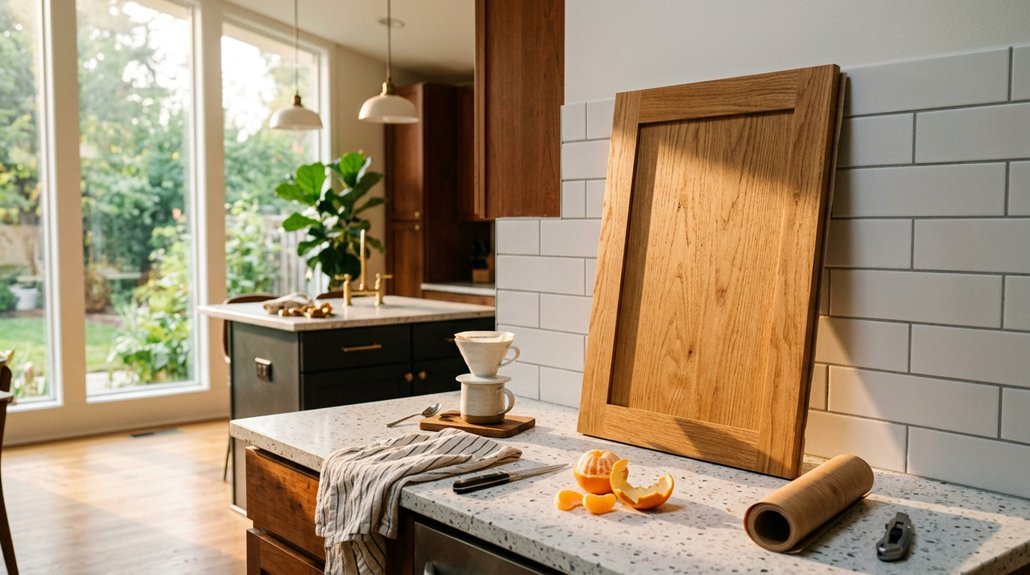
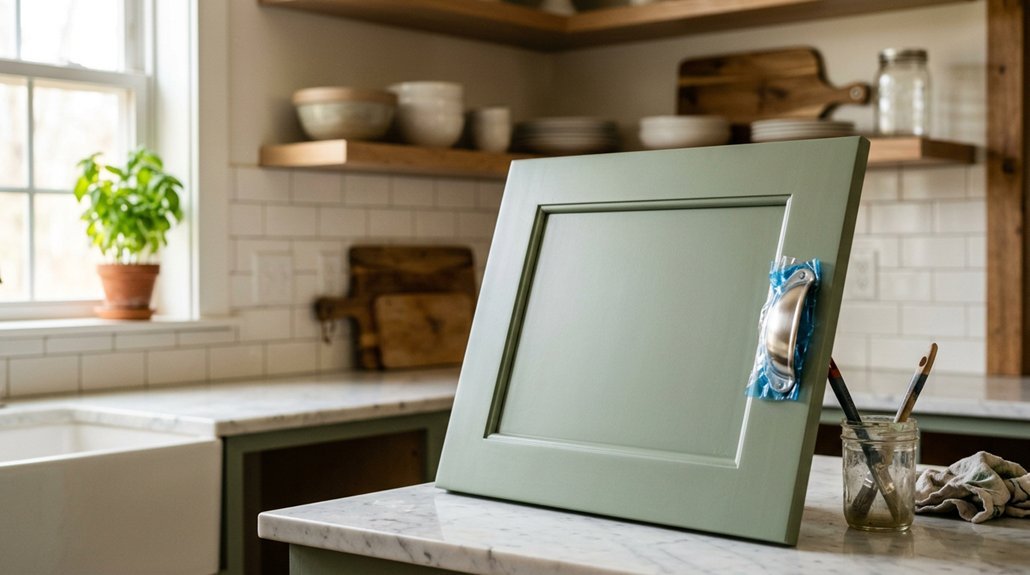
You stand in your kitchen, running your hand along cabinet edges, and you notice the thin hardwood border framing each door, or perhaps you don’t see one at all.
That single visual clue, that 1.5-inch face frame or its absence, shapes every practical decision you’ll make about storage, installation labor, and long-term durability.
You’re choosing between two engineering philosophies, and the wrong match will cost you inches of drawer depth, hours of leveling frustration, or sightlines that clash with your home’s character.
Seven measurable differences separate these systems, and you need each specification before you commit your budget.
Framed or Frameless Cabinets: Which Fits Your Kitchen?
When you’re deciding between framed and frameless cabinets, you’ll need to weigh how much you value traditional styling against everyday practicality.
Framed cabinetry gives you that classic look with its solid wood face frame, measuring about 1.5 inches wide by 3/4 inch thick, and you’ll get easier installation since that frame provides a mounting point and resists racking. If your walls aren’t plumb or your floors aren’t level, framed cabinets forgive those imperfections more readily.
Framed cabinets offer timeless elegance and forgiving installation—perfect for imperfect walls and floors.
Frameless cabinet construction removes that face frame entirely, so you gain full access to interiors and easier access to contents without obstructions. This construction allows up to 15% more storage inside. However, you’ll need precise installation with expert alignment for proper reveals.
For door styles, framed options support standard overlay, inset, or Full Overlay designs, while frameless systems pair best with modern Full Overlay choices. Both prove durable when well built; you simply choose between installation precision plus interior access versus easier installation plus classic appearance.
Do Frameless or Framed Cabinets Give More Storage?
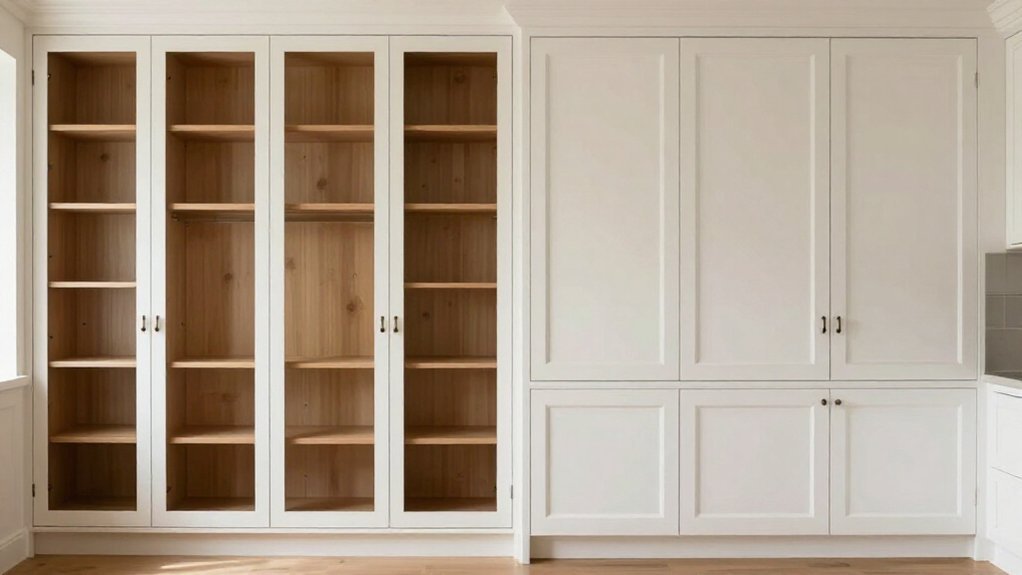
You’ll notice frameless cabinets give you roughly 15% more interior space than framed units of identical dimensions, since they eliminate the 1.5-inch face-frame lip that otherwise eats into your opening. That extra volume translates directly into wider, deeper drawer capacity, so you’ll fit bulky mixing bowls and servingware without wrestling around obstructions.
If you choose framed construction instead, you’re accepting reduced usable capacity from the face frame itself. Double-door designs may also include center stiles that further block access to rear corners and oversized platters.
Interior Space Comparison
Because the face frame consumes roughly 1.5 inches of opening width on all sides, framed cabinets surrender usable space that frameless designs retain for your storage needs. You’ll gain up to fifteen percent more interior space when you choose a Frameless cabinet box, as the missing face frame opens the full cabinet interior.
With Framed construction, the face frame lip narrows your usable opening, and the center stile blocks large items from easy access. You can slide appliances and platters into the back corners of a frameless unit, maximizing every inch of storage space. The unobstructed access to the interior also simplifies organization.
If you’ve got maximum capacity needs, you should consider frameless designs, though framed cabinets still offer durable construction many homeowners prefer.
Drawer Capacity Advantage
The interior width you gained from losing the face frame directly affects how much your drawers can actually hold. Frameless Kitchen Cabinets remove the face frame entirely, so you’re gaining roughly 15–20% more usable interior storage in the same footprint.
With Frameless construction, you can specify wider drawer openings, and that means your drawer box itself grows. Wider box construction lets you slide in bulky casters, nested mixing bowls, or wide platters without wrestling around a lip.
Framed cabinets still function, but the face frame reduces your clear cabinet opening, and that trims your drawer capacity. If you want maximum drawer capacity and easier access to everything inside, frameless is your straightforward choice. Just measure your items, check your drawer box depth, and you’ll know which construction fits your kitchen workflow.
Access Limitations Explained
Inside every cabinet, that ~1.5-inch face-frame lip determines how easily you can slide in a wide platter or retrieve a heavy Dutch oven from the back corner. When you compare framed and frameless cabinets, you’ll notice the interior solid unobstructed full box of frameless designs gives you up to 15% more usable space.
Without a center stile blocking your path, you gain cleaner access to the cabinet interior for wide/deeper drawer layouts and bulky appliances. Framed cabinets often include a center stile between double doors, which can obstruct access to the back corners where you store tall stockpots. That door and drawer opening feels tighter, even with careful organization. If you want maximum storage and smoothest retrieval, frameless construction usually wins, though framed options offer traditional structure you may prefer for looks.
Full Access vs. Center Stile: What Reaches Easier?
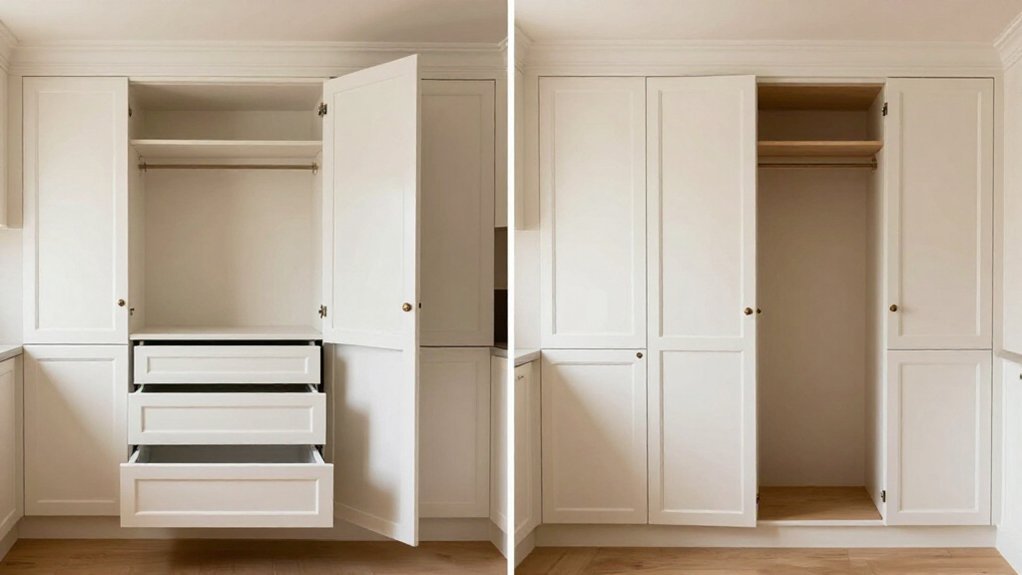
How much easier can you reach into a cabinet when nothing blocks the opening? With frameless cabinetry, you get full access because there’s no face frame or center stile narrowing the interior opening. You can slide platters straight to the back, and wider, deeper drawers hold awkward cookware without interference.
Framed cabinets rely on that face frame for structural support, and many door styles include a center stile between double doors. That stile blocks part of the opening, so you lose easier reach when retrieving large items from far corners.
If you prefer framed cabinets, choose designs with no center stile. This removes the obstruction and restores most of the accessible space. You’ll still deal with the face frame lip, but your reach improves noticeably for deep storage.
Are Frameless Cabinets Harder to Install Than Framed?
Why do installers often prefer framed cabinets over frameless ones? Frameless cabinets typically prove harder to install because they call for exacting conditions that framed cabinets can handle more readily.
Framed cabinets forgive imperfect walls; frameless cabinets demand precision.
Three factors raise the difficulty:
- You must ensure walls are plumb and level, plus floors are level, or door and drawer reveals will show uneven gaps.
- You lose the face frame’s hiding power; without it, imperfections stay exposed, forcing tighter installation tolerances.
- You fasten through side panels with shorter screws, requiring careful alignment, and you must verify cabinet box square to prevent racking.
If your space falls short of these tolerances, frameless systems need extra fillers or applied panels for smooth results, steps rarely necessary with framed cabinets.
Why Frameless Cabinets Aren’t Actually Less Durable
Frameless cabinets derive their strength from substantial box construction, not a face frame. Thicker furniture-board panels and precision dadoed joints create a rigid structure that rivals any framed alternative.
European hinge engineering plays a critical role too. These hardware systems distribute door weight across the entire cabinet side rather than concentrating stress at frame attachment points. Proper racking prevention design through engineered corner bracing addresses the one genuine vulnerability these cabinets face during shipping and rough handling.
When you evaluate durability, you should weigh material thickness, joinery quality, and installer skill far more heavily than cabinet style. A well-built frameless box performs like a tank without sacrificing the storage accessibility you gain from eliminating that front frame.
Box Thickness Matters
Although many homeowners assume frameless cabinets lack the ruggedness of their framed counterparts, this perception stems from visual assumptions rather than structural reality. When you examine cabinet boxes closely, you’ll find frameless cabinetry achieves comparable durability through alternative engineering strategies.
In framed cabinets, a ¾” thick × 1½” wide face frame serves as the structural backbone, adding rigidity and door mounting points. Frameless cabinets compensate through:
- Thicker, better-braced box panels forming the primary construction
- Superior furniture-board materials and precise joinery techniques
- Factory-finished panels resisting twisting and racking at the front edge
Your box thickness directly determines structural integrity, and proper frameless designs deliver equivalent strength. You must remember tolerance requirements differ materially; frameless installations demand plumb walls and level floors since no face frame masks minor alignment errors.
European Hinge Engineering
Because frameless cabinets eliminate the face frame entirely, you must rely on the hinge hardware and box engineering to deliver the durability you expect from quality cabinetry. European hinges use concealed mounting hardware that attaches directly to the cabinet box side panels, so your door alignment depends on properly engineered box construction rather than a face frame.
Frameless doors typically use full-overlay setups with tight tolerance requirements, achieved through precisely machined side panels and accurate installation. Quality European hinges feature engineered geometry and adjustment ranges that compensate for minor variances without weakening structure.
While a frame helps hide gaps in framed systems, you’ll find that professional installation and correct filler planning make frameless cabinets feel equally solid. The cabinet box itself resists stress through dadoed joints and thicker, more rigid materials, delivering long-term performance you can trust.
Racking Prevention Design
European hinge engineering solves the mounting challenge, but you might still wonder whether frameless cabinets hold up structurally over years of daily use. Let’s examine racking prevention design in Framed vs. frameless systems.
A solid wood face frame, typically 3/4″ thick and 1-1/2″ wide, mechanically ties the cabinet box front, acting as a rigidity backbone against twisting.
Frameless cabinets aren’t inherently weaker; with thicker sides, firmer back construction, and precise assembly, they resist racking equally well under load.
Installation precision matters most: frameless systems demand plumb, level walls with tight tolerances, while a solid wood frame can mask minor imperfections, making interior alignment easier for installers.
Racking stems mainly from out-of-square installation or uneven bases, so both styles fail if you ignore proper mounting. Frameless units may rack more during shipping without secure packing, but professional handling prevents this entirely.
Door Overlays: What Only Framed Cabinets Offer
Since frameless cabinets lack a face frame entirely, you’ll only get traditional door overlay choices when you choose framed construction, and that solid face frame becomes the defining feature that creates the visible “reveal” around each door.
With framed cabinets, you pick from three door overlays. Standard partial overlay leaves about 1-1/8″ of face frame exposed, while full overlay covers more, leaving roughly 1/4″. Inset doors sit flush, exposing the entire frame. These options let you control the look.
If you eliminate the face frame with a frameless cabinet, you lose these choices entirely. Frameless doors mount straight to the box, so you can’t get that framed reveal effect. Choose framed if overlays matter to your kitchen’s style.
Traditional or Modern: Picking Cabinets for Your Kitchen
Although framed cabinets use a solid wood face frame, doors attach directly to frameless boxes, and this determines whether your kitchen leans traditional or modern. You will find that traditional framed cabinetry suits classic aesthetics, while frameless cabinet construction delivers European, Modern design appeal.
Consider these factors when choosing:
- Overlay doors on framed cabinets create varied visual layers, from inset to full coverage, complementing ornate hardware and moldings.
- Cabinet doors on frameless boxes mount flush against edges, eliminating the solid wood face frame border for cleaner sightlines.
- Interior capacity differs: frameless yields roughly 15% more usable space, though installation demands stricter precision to achieve that Modern look without visible joints.
Framed tolerates minor wall imperfections; frameless requires level surfaces. Match your selection to your home’s character, your tolerance for installation rigor, and your storage priorities.