You need roughly 5,000 to 6,000 BTUs for a typical small bedroom, but your exact requirements depend on square footage, ceiling height, sunlight exposure, and occupancy.
Start with 20 BTUs per square foot, then adjust upward for south-facing windows, ceilings over eight feet, or extra occupants beyond two people.
Oversizing wastes energy and leaves clammy upholstery, while undersizing strains the compressor and never cools properly.
Window units suit most spaces, but portable models with casters work for rentals, and mini-splits offer quiet efficiency if you can mount the condenser.
The real question is whether your specific room conditions demand the upper end of that range, or if you can get away with something smaller and cheaper.
Start Here: 5,000–6,000 BTUs for Most Small Bedrooms
For most small bedrooms, you’ll want to start your search with units rated between 5,000 and 6,000 BTUs, as this range handles the majority of spaces measuring roughly 100 to 168 square feet. A single British Thermal Unit measures heat energy, and you’ll need about 5,000 BTU to cool a compact room of roughly 100 square footage, such as an 8 by 10 foot space. If your room expands toward 168 square feet, like a 12 by 14 foot layout, you’ll likely require closer to 6,000 BTUs.
Shade and sun exposure shift these figures; reduce your estimate by 10% for very shady rooms, or increase it by 10 to 15% for sun-drenched spaces with south-facing windows and minimal upholstery coverage. When your calculation falls between sizes, choose the larger air conditioner you need, but avoid exceeding your calculated requirement by more than 15%, as oversized units cycle inefficiently and waste energy without improving comfort.
How to Calculate Your Small Bedroom’s Base BTU Needs
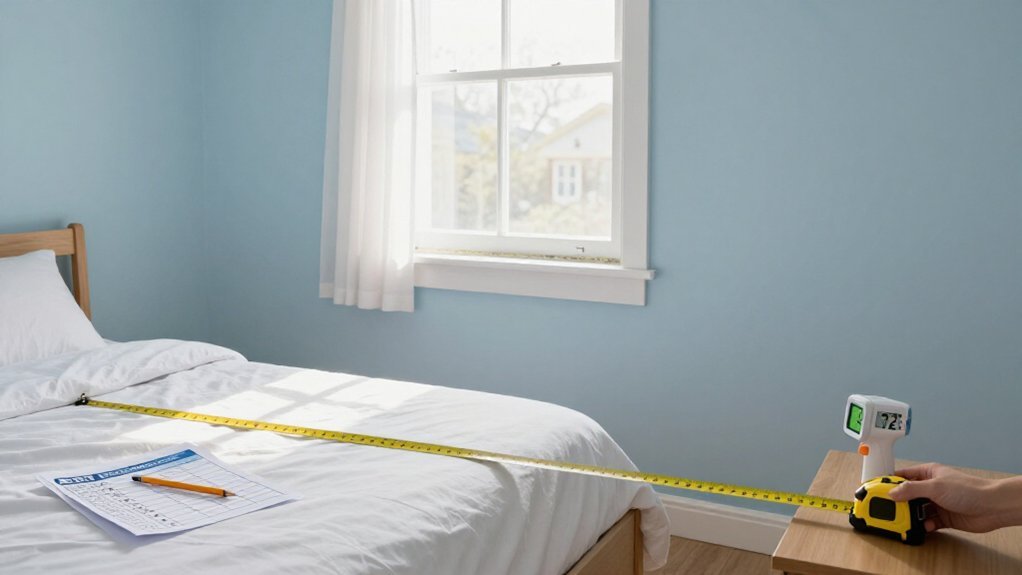
To determine exactly what your small bedroom needs, you’ll calculate the base BTU requirement yourself rather than relying on general estimates. This process begins with a simple tape measure and some basic arithmetic.
Measure your room’s length and width in feet, multiply to find your square feet, then apply the standard rule of thumb: 20 BTUs per square foot. A 180 square foot room needs roughly 3,600 BTUs to maintain comfortable air temperature and manage heat removal effectively.
If your small bedroom connects to another space without a door, combine both areas’ square footage before calculating. When your final BTUs fall between standard unit sizes, select the larger size air conditioner, but don’t exceed your calculated needs by more than 15% for best efficiency and humidity control.
Adjust Small Bedroom BTUs for Ceiling Height and Sunlight
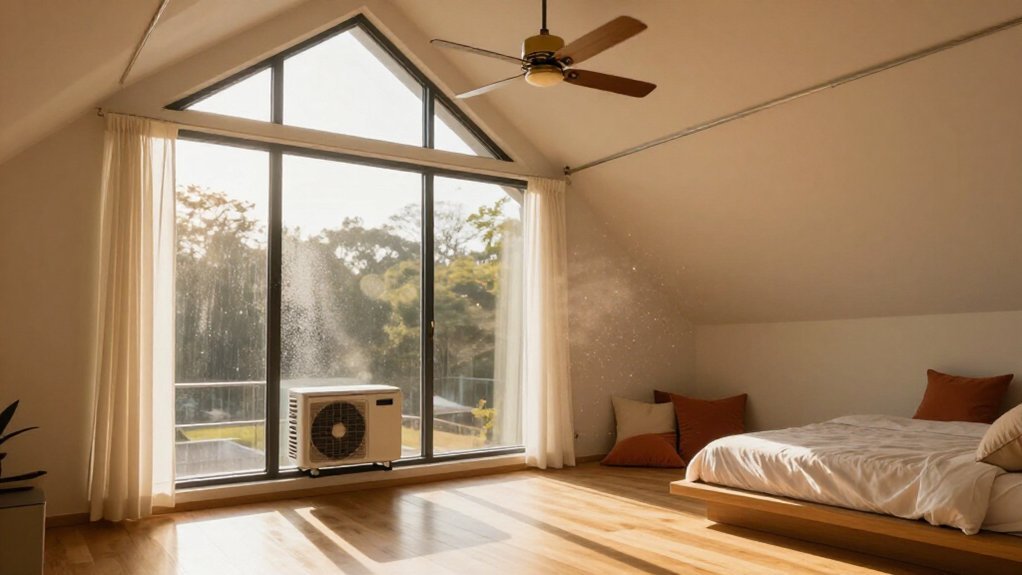
Once you’ve calculated your base BTUs from square footage, you’ll need to adjust that number for two factors that greatly impact cooling performance: ceiling height and sunlight exposure.
If your ceiling height exceeds eight feet, add ten percent for each additional foot; a ten-foot ceiling demands roughly twenty percent more BTUs required than standard rooms. For Window air conditioners in one room with strong sunlight, increase your estimate by ten to fifteen percent, since solar heat gain strains cooling capacity. Conversely, heavily shaded spaces allow you to subtract ten percent.
These adjustments prove especially critical in warmer climates, where unaddressed heat loads overwhelm undersized units. Apply percentage modifiers to your base calculation rather than recalculating from scratch, ensuring precise capacity without overspending on excessive casters or upholstery-damaging humidity.
Add BTUs for Extra People in Your Small Bedroom
After you’ve adjusted your base BTUs for ceiling height and sunlight, you’ll need to account for the heat that bodies generate. Each person radiates warmth, so you’ll add 600 BTUs for every extra occupant beyond the first. If two people share your small bedroom, add 600 BTUs to your total; for three people, add 1,200 BTUs. These people-based BTUs stack onto your room-based calculation, not replace it.
Unlike a common room where guests come and go, bedrooms have consistent overnight occupancy, so you can’t skip this step. Combine your room-based BTUs and people-based BTUs, then round up to the next cooling capacity option if you land between sizes. Undersizing risks chronic undercooling, even with proper airflow and thermostat settings.
What Happens If You Pick the Wrong Size?
Because you have sized your unit carefully, you might assume any nearby BTU rating will work. Even small mismatches create measurable problems in a compact bedroom. When you pick the wrong number of BTUs, your air conditioning fails to perform as casters and upholstery deserve in a controlled climate.
Your square footage determines the baseline. Each variable, like sun exposure or ceiling height, can require more Btus than the rough number suggests. Consider these consequences:
- Undersizing leaves you sweating for over 24 hours in a walk-in-closet-sized space
- Oversizing triggers short cycling, so you feel uneven cooling instead of steady comfort
- Exceeding the 15% buffer wastes energy and degrades performance
- Wrong assumptions about room conditions create the “doesn’t cool even half” result
Match your Btu rating precisely, or you’ll sacrifice both efficiency and ice-cold consistency.
Why 12,000 BTUs Is Too Much for a Small Bedroom
Although a 12,000 BTU window unit promises serious cooling power, you’ll likely find it overwhelms a compact bedroom under 150 square feet. You need roughly 20 Btu per square foot, so a 10×10 room needs about 2,000 BTUs, and practical minimums land near 5,000–6,000 Btus needed for reliable operation.
A 12,000 Conditioner blasts far more capacity than the amount of heat your small space actually generates. You’ll watch it cycle on and off constantly, and that stuttering pattern prevents steady humidity removal, so the room feels clammy rather than crisp. The unit shuts down before airflow can effectively cool every corner, especially past furniture with thick upholstery or casters blocking vents.
You pay extra for power you cannot use, and you sacrifice comfort for brute force.
Window, Portable, or Mini-Split: Best AC Types for Small Bedrooms
When you’re cooling a small bedroom, you’ll need to weigh three distinct options, each with its own trade-offs in performance, installation, and long-term efficiency.
A window unit often tops out around 12,500 BTUs, covering roughly 650 sq ft, though even 12,000 BTU models can struggle if your heat load runs higher than expected. Portable units, which roll on casters and vent through flexible hoses, max near 14,000 BTUs for spaces around 500 sq ft, but you’ll lose efficiency if the window seal leaks or the exhaust fit isn’t airtight.
Mini-split systems, permanently mounted on walls, scale impressively: a single outdoor compressor can distribute up to 56,000 BTUs across four indoor heads, making them ideal if you want to cool the room or house beyond just one bedroom.
To choose wisely, consider these factors:
- Measure square footage, then add 10–15% for sunny exposures
- Add 10% per foot of ceiling height over 8 ft
- Verify your electrical outlet matches the unit’s plug type
- Select higher BTU only when heat-load factors demand it, not by default