You are looking at $500 to $1,200 per linear foot for custom kitchen cabinets installed, so a standard 20 to 30 linear foot kitchen runs $6,000 to $30,000 or more.
Base cabinets start near $495 per linear foot, uppers fall around $440 to $528, and pantry units hit roughly $1,320 with their complex organizers.
Lead times run 8 to 12 weeks, but seven overlooked factors can swing your final quote dramatically, and you will want to know where you can trim costs without sacrificing solid wood drawer boxes or soft-close casters.
What Do Custom Kitchen Cabinets Actually Cost?
Although sticker shock can hit hard when you first price custom kitchen cabinets, you’ll find the numbers become manageable once you break them down by linear foot. Custom Cabinets Cost typically runs $500 to $1,200 per linear foot installed, so you’ll pay roughly $6,000 to $30,000+ for a standard 20 to 30 linear foot kitchen.
Your Cost Per Linear depends on cabinet type: base cabinets with full-height doors start around $495/lf, drawer-over-door bases hit $660/lf, and uppers range $440 to $528/lf. The Cost of custom cabinetry reflects premium materials like 3/4 maple plywood, KCMA-grade finishes, and soft-close hardware. Storage upgrades, including heavy-duty pullouts rated to 130 lbs, push your per linear foot price higher.
Labor and Installation are included in most fully custom quotes. When you compare stock vs semi-custom options, you’ll see KITCHEN CABINETS at this tier demand higher investment for superior construction and tailored dimensions.
Custom vs. Semi-Custom vs. Stock Kitchen Cabinets
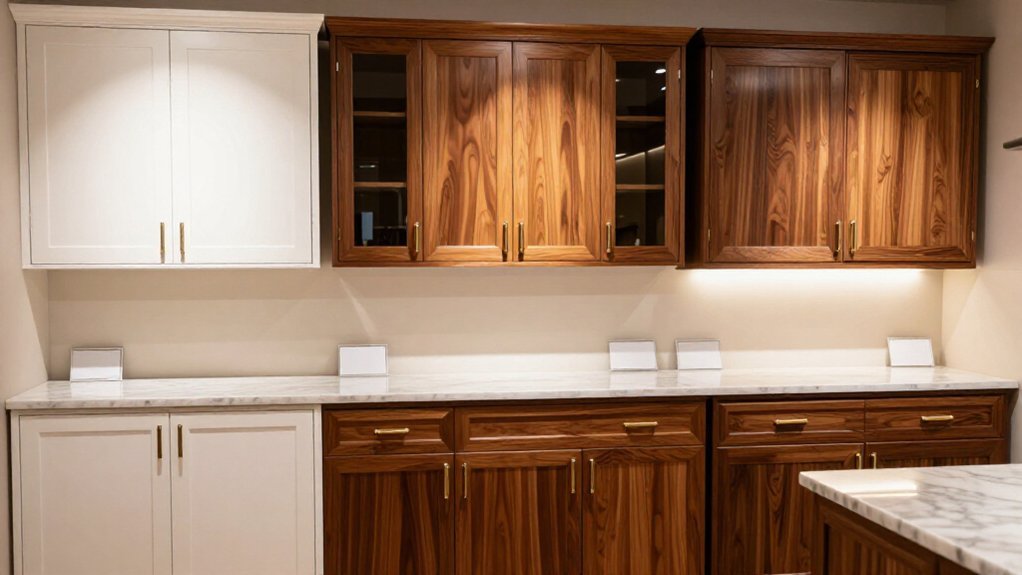
When you’re weighing cabinet options for your kitchen, you’ll need to understand how stock, semi-custom, and custom tiers differ in construction, cost, and flexibility. Stock cabinets offer a cost-effective choice at $100–$300 per linear foot of cabinetry, but you’ll sacrifice flexibility with limited sizes and finishes.
Semi-custom cabinets expand your options to $150–$650 per linear foot, letting you adjust door styles and some dimensions. When comparing semi-custom cabinets vs custom, the gap widens considerably: fully customized builds run $500–$1,200 per linear foot, with base cabinets starting at $495 and uppers at $440–$528. Cabinet pricing reflects this hierarchy, as custom work demands exact-fit fabrication and premium hardware like soft-close hinges.
Semi-custom cabinets offer middle-ground flexibility at $150–$650 per linear foot, while custom builds command $500–$1,200 for exact-fit craftsmanship and premium hardware.
- You deserve cabinets that fit your life, not a factory template
- Your kitchen’s quirks shouldn’t force compromises you’ll regret daily
- Imagine opening drawers that glide like whispered promises
- Picture every inch serving your family’s unique rhythm
- Feel the difference when craftsmanship honors your vision
How Long Do Custom Kitchen Cabinets Take?
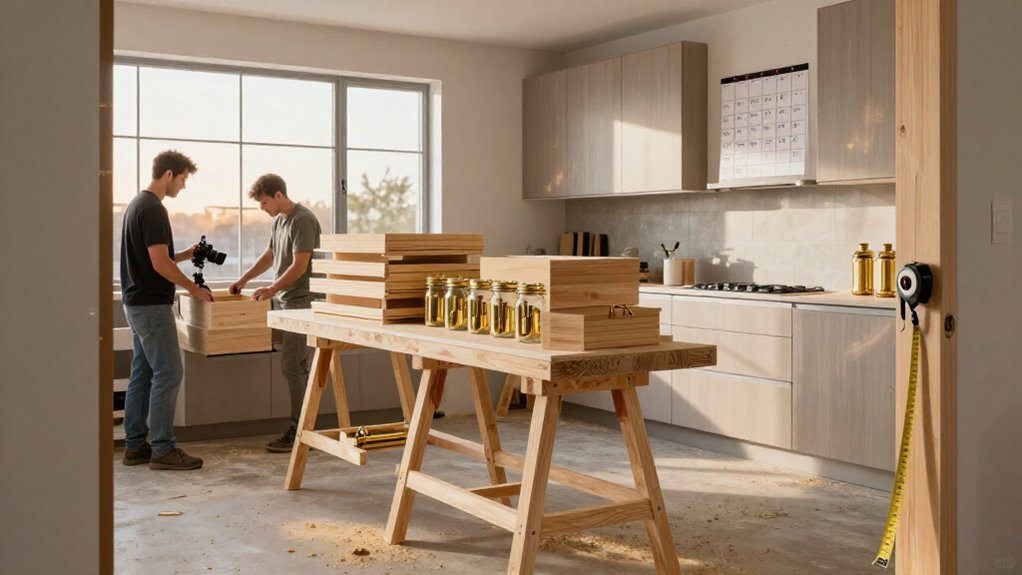
You should expect your custom cabinets to take roughly 8–12 weeks for fabrication, which is noticeably longer than the two-week timeline you’d get with stock or RTA alternatives. Your overall installation window will likely stretch another 2–4 weeks, and that timeline can expand further if you’re ordering specialty units like pullout garbage/recycle drawers or multiple drawer bases with full Euro style construction.
You ought to build in a 10–20% contingency buffer, since custom projects involving detailed KCMA-standard finishes and complex assembly can encounter scheduling surprises that delay both fabrication and installation.
Typical Lead Times
Because custom kitchen cabinets are built to your exact specifications rather than pulled from warehouse inventory, you’ll typically wait 8 to 12 weeks from order to delivery, and that’s before installation even begins. Your kitchen remodel demands patience, since lead times for custom cabinets stretch far beyond stock or semi-custom cabinets.
Euro full-access construction, 3/4 maple plywood components, and KCMA-compliant finishes require precise fabrication. Complexity adds duration: soft-close hinges, drawer slides, pullout shelves, and garbage/recycle pullouts must each be fitted and confirmed during production. Larger projects spanning 30 to 40 linear feet take longer than compact jobs. You’ll also need a 2 to 4 week installation window after delivery, as production and install remain separate phases.
- You watch your unusable kitchen stretch on for months.
- You juggle temporary cooking arrangements that frustrate daily routines.
- You question whether the wait justifies the investment.
- You feel relief when precise craftsmanship finally arrives.
- You discover the payoff in smooth, tailored function.
Installation Timeline Factors
Although custom cabinets demand a longer commitment than stock alternatives, you’re looking at roughly 8 to 12 weeks of manufacturing before installation even begins. That’s largely because your order isn’t pulled from a warehouse.
Custom cabinets can range in build time based on your customization options, like stain with clear topcoat versus painted finishes, plus interior and exterior finishing that meets KCMA standards. Full-access Euro style construction with 3/4 maple plywood and dowel-and-screw assembly adds time versus pre-manufactured systems. Your kitchen layout, especially beyond 40 linear feet, and special storage add-ons like pullouts or soft-close hardware, affect scheduling. Average prices and installation costs reflect these materials and labor demands.
Plan for cabinet installation to run 2 to 4 weeks after manufacturing completes.
How Linear Foot Pricing Works for Custom Cabinets
You measure linear feet by running your tape along the wall where cabinets will sit, since this total length determines your base cost before you select door styles, drawer configurations, or upper cabinet heights. Your quote tiers upward as you choose premium options like drawer stacks over simple doors, taller uppers beyond 24 inches, or specialty hardware, so each specification stacks additional cost onto the foundation footage.
You should anticipate installed custom work landing between $500 and $1,200 per linear foot, though your final number depends on how many variables, casters, or upholstery-adjacent details you specify for your layout.
Measuring Linear Feet
How do cabinet makers actually calculate what you’ll pay for custom storage? They use linear foot pricing, and measuring linear feet will help you make sense of your custom investment.
You measure each wall run where CABINET boxes will live, recording the total length in feet. A Base Cabinet run of ten linear feet at $495/LF costs $4,950, while drawer-over-door bases at $660/LF push that same run to $6,600. Upper cabinets follow similar math, with height tiers from $440/LF to $528/LF, and pantry units hitting $1,320/LF. Add per-drawer surcharges, like $330 each, for accurate pricing.
The average cost of custom cabinet work shifts dramatically when you change configurations, not just add boxes. Linear pricing means layout choices compound, so measure carefully, multiply precisely, and track every foot.
You feel relief when your tape reveals a shorter run than you feared. You panic realizing one extra drawer base adds thousands, not hundreds. You resent discovering pantries cost triple standard uppers. You regret not double-checking corners that waste linear footage. You trust the process when numbers finally expose true custom Cost.
Pricing Tier Breakdown
When you’re comparing custom cabinet quotes, you’ll notice each tier carries a distinct per-linear-foot rate that reflects what’s actually going into your kitchen. The Average Cost of Custom cabinetry costs depends on how you configure each linear foot.
Base cabinets run $495 per linear foot for full-height doors, or $660 with drawers over doors. Drawer base cabinets hit $660 per linear foot plus $330 for each drawer. Upper cabinets scale from $440 to $528 per linear foot by height, while pantry cabinets command $1,320 per linear foot.
This tiered structure means two kitchens with identical wall runs can show very different Cost of custom cabinets. You will Influence Custom Cabinet totals by multiplying each cabinet run by its tier rate, not averaging everything together.
Cost Factor Variables
Because custom cabinet quotes rely on linear-foot measurements, you’ll pay for every foot of wall run your kitchen occupies, and that total shifts dramatically depending on which cabinet types you select. Your cost factors include materials selection, layout complexity, and whether you choose stock options or custom builds.
You watch your budget climb when base cabinets with drawers over doors cost $660 per linear foot, not $495 for full-height doors. You feel cornered by specialty units that demand extra frames, hardware, and labor for garbage pullouts. You notice upper cabinets jump from $440 to $528 per linear foot as height bands increase.
You value full access construction, soft-close casters, and 11-1/4″ depth, but each spec upgrade raises your linear foot total. You discover pantry cabinets hit $1,320 per linear foot, so plan your layout carefully.
How Kitchen Size Changes Your Custom Cabinet Budget
Although you might focus on finishes first, your kitchen’s actual dimensions will likely dictate whether you’re spending closer to $6,000 or well over $50,000 on custom cabinetry. Your kitchen size directly determines your total linear feet, and that measurement sets your baseline cost for custom work per kitchen.
A compact space with 20 linear feet of base cabinets might run $6,000–$14,000, while a standard-sized kitchen near 40 linear feet jumps to $12,000–$28,000. Large kitchens, especially those spanning 30–40 linear feet, frequently exceed $50,000 when your cabinetry design incorporates specialty storage.
You will find that every additional foot expands material needs, labor, and hardware counts. Ultimately, your custom kitchen budget scales proportionally with wall-to-wall measurements, making accurate linear footage your most critical planning tool.
Why Base, Upper, and Pantry Cabinets Cost Different Amounts
Your cabinet type selection drives your project’s cost structure more than many homeowners initially realize, and you’ll need to weigh each category’s functional returns against its price premium. Base cabinets command higher linear foot costs than upper cabinets because they support heavier loads and demand robust drawer configurations, full-height door styles, and hardware for hidden trash or pullout casters. Upper cabinets run lighter at $440–$528 per linear foot since they handle less weight and simpler storage.
Pantry cabinets cost the most, typically $1,320 per linear foot, as this cabinetry offers specialized height, depth, and integrated organization that stock versus custom builds rarely match. Your choice between doors-only and drawer-forward designs directly impacts pricing, with each upgrade adding measurable cost per linear foot.
- You watch base cabinet costs climb 33% when you choose drawers-over-doors instead of basic door styles
- You feel pantry sticker shock at triple the rate of uppers, even before filling them
- You discover hidden trash solutions and soft-close upgrades compound faster than expected
- You realize upper cabinets save money but limit what your kitchen can actually store
- You face the stock versus custom gap widening most painfully at pantry scale
7 Factors That Increase Custom Cabinet Prices
Whether you’re expanding your kitchen’s footprint or refining its workflow, you’ll find that seven distinct variables determine where your custom cabinet investment lands on the pricing spectrum. Factors that influence your KITCHEN cabinetry cost start with size: more linear feet and bigger layouts raise prices fast, with custom runs commonly landing around $500 to $1,200+ per linear foot installed.
Material upgrades make a significant difference, too; you’ll pay more for premium hardwoods and higher-grade plywood, while MDF typically runs $300 to $400 per foot, and white oak or cherry command even higher rates. Extra hardware, specialty features like soft-close hinges, and organizer inserts add labor and components.
Construction complexity, including full-access Euro-style builds with 3/4 maple plywood, increases fabrication time. Finally, layout intricacy with corners, islands, or ceiling-height runs pushes engineering effort and totals beyond stock alternatives.
Where to Save on Custom Kitchen Cabinets
Those seven cost drivers don’t mean you’re locked into premium spending, and you can trim thousands from your estimate without gutting your kitchen’s function or durability. You make custom cabinets worth the investment by knowing where to cut, not corners.
Knowing where to cut, not corners, makes custom cabinets worth the investment without sacrificing function or durability.
You feel relief when you skip fancy storage features, like pull-out casters, and still keep your kitchen whole. You breathe easier choosing MDF over premium hardwoods, because material selection saves you $75–$200 per foot.
You smile at simpler layouts, since design flexibility with odd corners costs 20%–40% more. You rest assured prioritizing essential features, like soft-close hinges, over every upgrade.
You discover hope in refacing instead of replacing, cutting bills 30%–50% when boxes stay solid. You compare quotes from cabinet makers, you find lower cost, and you win.
How to Get Accurate Custom Kitchen Cabinet Quotes
Because vague estimates lead to budget surprises, you need to request quotes built on lineal footage with category-specific pricing that matches your actual cabinet configurations. When you gather custom kitchen cabinet quotes, insist that costs depend on precise height tiers, like uppers ≤24″ at $440/lf or pantry units at $1,320/lf.
You should verify that materials metrics appear explicitly, including 3/4 maple plywood sides, 11-1/4″ upper depths, and dowel-and-screw assembly. Confirm your quote encompasses full access Euro construction, soft-close undermount slides, 110° soft-close hinges, and KCMA-exceeding finishes.
Provide detailed plans so vendors price each cabinet accurately. Compare quotes line-by-line for assumed add-ons, such as pull-out spice racks, heavy-duty garbage pullouts, and finished toe kicks. This diligence helps you make an informed decision and avoid hidden expenses.