You probably don’t realize that a sofa’s frame type determines more than half its lifespan before you even sit down. Kiln-dried hardwood, engineered plywood, and particleboard each age differently under daily stress, and most shoppers never check.
A $800 sofa with thin gauge webbing and 1.8-pound foam density might sag within thirty-six months, while a $2,200 model using eight-way hand-tied springs and 2.5-pound resilience foam often exceeds a decade.
Your purchase hinges on knowing which construction details justify the price jump, and which ones just pad the margin.
Sofa Prices in 2026: What $800, $2,000, and $5,000 Buy You
When you’re shopping for a sofa in 2026, you’ll quickly notice that price tiers create distinct categories of construction, materials, and expected lifespan. At $800, you’re buying entry-level pieces with engineered frames and basic upholstery, giving you roughly 3 to 5 years of daily use.
Move to $2,000, and you’ll find stronger construction, often solid hardwood frames or quality plywood, plus denser cushioning that extends lifespan to 7 to 10 years. The $5,000 price range delivers premium components: kiln-dried hardwood, superior support systems, and full-grain leather options, with potential 15-year lifespans.
Foam density matters most for longevity; high-density cushions outlast low-density alternatives substantially. Always verify specifics regardless of Sofa Cost, checking frame material, cushion density, and leather grade to avoid overpaying for weak construction.

EXQUISITE CRAFTSMANSHIP: Meticulously crafted with a kiln-dried hardwood frame and solid stainless steel legs showcasing durability; The 3 piece living room set includes the sofa, loveseat, and chair

Blackjack Furniture Catania Modern Italian Leather Sofa Set for Living Room with Kiln-Dried Hardwood Frame and Solid Stainless Steel Legs, Premium Top Grain Upholstery, Couch, White

Blackjack Furniture Catania Modern Italian Leather Sofa Set for Living Room with Kiln-Dried Hardwood Frame and Solid Stainless Steel Legs, Premium Top Grain Upholstery, Loveseat, White
How Much Should You Spend? A 3-Minute Budget Framework

Because you’re deciding how much to spend on a sofa, start by matching your budget to your actual timeline. The cost of a sofa varies dramatically, so what the average cost depends on is how long you need it to last.
Match your sofa budget to your timeline: cost varies dramatically based on how long you need it to last.
- For 1–3 years, plan $800–$1,200; price usually reflects basic construction.
- For 5–10 years, target $1,500–$2,500 for better comfort and durability.
- For 15+ years, invest $2,500–$5,000+, prioritizing hardwood frames and high-resilience cushions.
You’ll find the best value by shopping at the right time: Presidents Day, Memorial Day, Labor Day, or Black Friday. Compare internal build quality to sticker price, measure your doorways and stairs, and factor in daily wear from kids or pets. Balance cost against construction, and you’ll secure lasting performance without overspending.

Replaces the eight way hand tie system for upholstery

How Sofa Size Affects Price: Standard, Modular, and Sectional
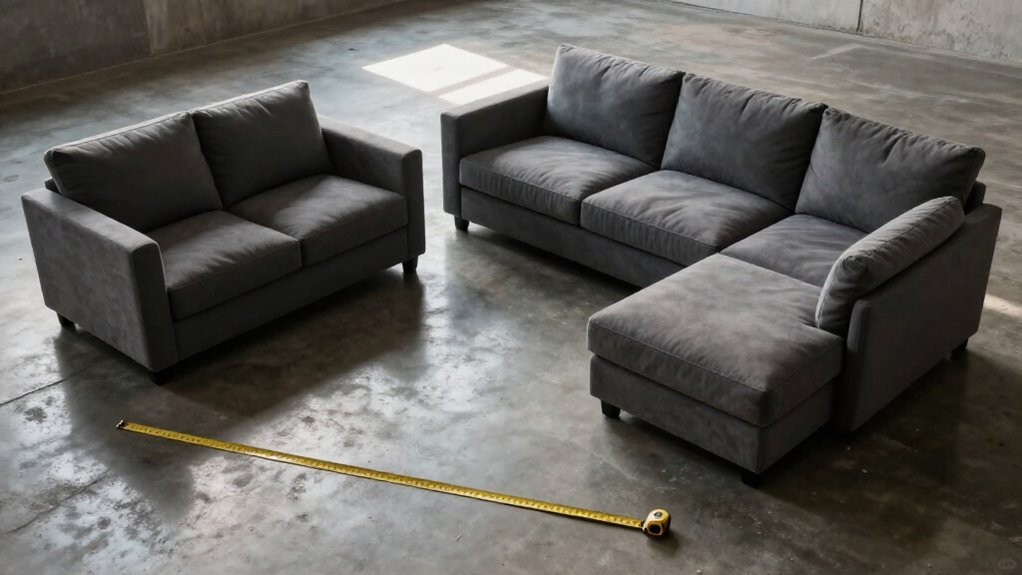
When you’re shopping for a sofa, you’ll notice that standard three-seaters typically start around $900 and often land between $1,600 and $2,200 for durable builds with quality upholstery and solid frames.
Modular configurations cost more than comparable standard sofas because each piece requires extra hardware and engineering to connect securely, even when the overall footprint stays similar. Sectionals command the highest prices due to their larger build size, which demands more cushions, longer frames, additional supports, and greater upholstery yardage. You should prioritize matching size to your actual space to avoid paying for unused construction bulk.

【Customizable Size】: You can customize the size you need through "Custom Size". 4 thicknesses of 1"/2"/3"/4" can be selected.

Premium High Density Upholstery Foam, Perfect for seat cushion replacement, couch cushions, bench cushions, and DIY upholstery projects. Provides reliable support and helps restore sagging furniture for improved comfort and durability

SIZE & SET INCLUDES - Deep seat cushion set includes 2 seat cushions (25" W x 25" D x 5.5" H) and 2 back cushions (25" W x 20" H). Designed to fit most outdoor sofas and chairs. Please measure your furniture carefully to ensure proper fit
Standard Sofa Pricing
Although you’re probably picturing a standard three-seater first, you’ll want to understand how sofa size directly shapes what you pay before you commit to any frame. A standard sofa offers the most predictable sofa price category, with entry-level decent-quality options starting around $900, and durable design-led versions commonly landing in the $1,600 to $2,200 range. When you compare prices across sizes, you’ll notice that smaller or simpler standard sofas often fall within $300 to $800, though these may use less robust frames made with lighter materials and basic foam cushions.
As you evaluate how sofas cost more at larger scales, consider these factors:
- More frame material increases base expense proportionally with length.
- Additional upholstery yardage raises fabric costs meaningfully.
- Upgraded internal components, like dense foam cushions, push prices toward $1,500 to $2,500 and above.
Modular Configuration Costs
If you want adaptable seating, you’ll pay a premium for modular engineering over a standard $900 to $2,200 three-seater. Modular configuration costs add up because each section uses locking joints, secure connectors, and extra hardware that standard frames don’t require. You’re buying engineered wood frames and high-density foam for every piece, not just one unit.
A sectional sofa commands even higher prices, since corner structures and deeper seats demand more material volume and complex assembly. When you configure L-shapes or oversized seating, expect delivery fees of $100 to $250 above standard shipping, as handlers maneuver bulky components through tight spaces.
Compare total measurements carefully: a compact-looking sectional can still carry a premium due to internal structure and how its seating area is engineered.
Sectional Size Premium
Every additional square foot of seating drives your cost upward, and sectionals exploit this principle aggressively. You will encounter the sectional size premium most acutely when comparing standard sofas to sprawling configurations, since materials scale directly with surface area.
Frame and upholstery materials multiply across extended dimensions, so a large sectional demands proportionally more wood, foam, batting, and fabric than compact alternatives. Modular designs require extra engineering for secure interlocking, which increases cost beyond built-in sectionals of equivalent seating capacity.
Performance fabrics and reclining mechanisms compound expenses disproportionately across larger footprints, as hardware must distribute throughout expanded frames.
Budget-conscious shoppers should anticipate spending $1,500 to $2,500 for durable daily use, though premium large sectionals with advanced features routinely exceed $3,000. Your square footage decisions directly determine final investment.
Why Some Sofas Cost $800 and Others Cost $8,000
You’ll notice that frame materials and craftsmanship create the widest price gaps when you’re comparing sofas side by side. A frame built from kiln-dried hardwood with reinforced corner blocking will outlast engineered wood or particleboard alternatives that sag within a few years, so you’re in fact paying upfront for longevity.
When you evaluate construction quality, inspect the joinery, lift the piece to gauge heft, and ask whether the suspension uses eight-way hand-tied springs or cheaper webbing, because these hidden components determine whether your $800 bargain becomes a $2,000 replacement in half a decade.

Size: Sectional couch connectors measure 2.95 x 2.6 inches and include screws, 4 pieces (2 sets). These modular couch connectors keep your sectional secure and stable

Applicable Scenarios: Our heavy-duty sectional couch connectors keep your sectional tightly connected, preventing sliding apart. Fit for regular sectional sofas with wooden load-bearing frames, split fabric/leather sofas (frame thickness ≥1.5cm); Not fit for fabric-only sofas without wooden frames, ultra-narrow edge sofas (frame <1.5cm), L-shaped irregular sectionals, or integrated sofas with no split gaps

Size Fit:Sofa latch connector With a length of 120mm, it's suitable for most sofa frames, enabling free - form splicing, The design size is relatively large and not suitable for small spaces
Frame Materials Matter
Because the frame hides beneath upholstery, it’s easy to overlook what actually determines whether your sofa lasts five years or fifty. Frame material sits at the heart of this equation, and you’ll want to understand what you’re actually buying.
Consider three tiers of frame quality:
- Entry-level: Engineered wood or particleboard, which warps within years and undercuts long-term value
- Mid-range: Kiln-dried hardwood or 3/4″ hardwood plywood, delivering roughly 10 years of support
- Investment-grade: 5/4″ solid wood like oak or maple, where a solid frame can endure 50+ years
Construction details, including joint quality and reinforced framing, prevent sagging. Even with identical upholstery, weak frame material explains why one sofa costs $800 and another commands $8,000. You’ll feel the difference in decade five.
Craftsmanship Drives Price
Frame material sets the foundation, but craftsmanship determines whether that foundation holds up under daily use. When you’re evaluating sofas, you’ll notice craftsmanship drives price more than surface appearance alone.
You should examine frame construction closely, since kiln-dried hardwood and reinforced joints outperform stapled softwood that loosens within years. Check whether eight-way hand-tied springs support the seat, or if you’re settling for stretched webbing that sags prematurely.
High-density foam changes how long you’ll enjoy your purchase: 2.5 density cushions maintain their feel for 10–15 years, while 1.8 density flattens in 1–5 years. Your solid living room investment depends on these hidden specifications.
Top-grain leather and performance fabrics matter, but they cannot compensate for weak internal assembly. At $3,000 and above, better materials and precise construction should deliver 15 years of service, not premature failure.
Is Your Cheap Sofa Actually a Bargain? Do the Cost-Per-Year Math
When you’re staring at a $400 sofa next to a $1,800 model, the cheaper option feels like an obvious win, but you’re not really comparing apples to apples until you break down what you’ll actually spend per year of use. A cheap sofa lasting 3–5 years can cost you $100–$133 annually, while a quality sofa at $1,800 lasting 10 years drops to $180, or less if you stretch it further.
Your cost per year depends on three critical factors:
- Foam cores: 1.8 density foam softens in 1–2 years under heavy use, while 2.5 density holds 10–15 years.
- Frame durability: mid-range frames typically last a decade, but weak webbing fails sooner.
- Brand premiums: a $5,000 trend-driven piece may deliver worse value than sturdy, lower-priced alternatives.
Comfort over time reveals true sofa costs.

Make Good Living Gettable: The Napa left facing sectional sofa by Poly and Bark is a premium leather couch featuring full-grain pure-aniline or semi-aniline dyed Italian leather upholstery. Our high-quality leather sofa is built to be the perfect living room centrepiece.

Make Good Living Gettable: The Napa left facing sectional sofa by Poly and Bark is a premium leather couch featuring full-grain pure-aniline or semi-aniline dyed Italian leather upholstery. Our high-quality leather sofa is built to be the perfect living room centrepiece.

Full-grain pure-aniline (cognac tan, cocoa brown) or semi-aniline (all other colors) dyed Italian tanned leather upholstery
What Drives Sofa Prices: Frame, Fill, and Fabric
Although you might fixate on style or brand when you first shop, you’re really paying for three hidden guts: the frame’s skeleton, the cushion’s fill, and the upholstery’s skin. Each element determines whether your sofa sags in three years or carries you through a decade.
Sofa price jumps when frames and high-density construction meet: kiln-dried hardwood beats particleboard every time. You’ll want solid joinery in your living room centerpiece, not engineered wood that loosens as seasons change.
Cushion fill seals the deal; 2.5-density foam keeps its lift for 10–15 years while 1.8-density flattens faster under heavier use. Bonded leather tempts bargain hunters, but that 10–20% real leather content peels within five years. Top-grain leather costs more, yet paired with quality framing it outlasts budget alternatives threefold.

[Premium Fabric Material]: Upholstered in woven polyester fabric with high-density foam seat cushions, delivering comfort and durability suitable for daily use in relaxation spaces

EXQUISITE CRAFTSMANSHIP: Meticulously crafted with a kiln-dried hardwood frame and solid stainless steel legs showcasing durability; The 3 piece living room set includes the sofa, loveseat, and chair
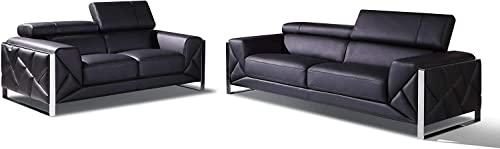
Bring that Lasting Luxurious Look to Your Space With the Gianni Sofa and Loveseat Set by Blackjack Furniture, Featuring an Elegant Contemporary Look with Genuine Italian Leather Upholstery in a Gorgeous Black Color
The Hidden Costs of a “Great Deal”: Delivery, Returns, and Warranties
Before you celebrate that clearance tag, you should know the checkout total rarely tells the full story. “Free shipping” often excludes white-glove service, and you’ll pay $100–$250 more if you want crews to haul the sofa past your threshold, navigate casters around tight corners, and position it in your living room.
That clearance price? It rarely covers the full story of getting your sofa actually into your living room.
Return policies can sting if you haven’t read the fine print. Watch for these common traps:
- Restocking fees of 20–30% plus return shipping costs, which erode your refund if the upholstery color clashes with your walls
- Short warranty coverage periods, though a 3-year warranty beats limited 1-year terms when springs fail
- Missing home trials, so prioritize retailers offering 30–100-day windows to test the frame and cushions
Factor delivery, setup, and protection plans into your real budget before you buy.
Is a $5,000 Sofa Ever Worth It?
Sticker shock hits hardest after you’ve calculated delivery fees and restocking risks, so you might wonder if spending more upfront actually solves the problem.
You might justify the higher price of a sofa when premium materials like kiln-dried hardwood frames and high-density cushions promise fifteen-plus years of use, dropping your annual cost near $333. However, you should inspect what’s inside. Low-density foam fails faster than upholstery, so you’re wasting money if the $5,000 tag buys only a designer label without eight-way hand-tied springs or engineered foundations.
Reclining sofas and oversized sectionals rarely earn their price through proportional longevity. If you’ll relocate or replace within five years, skip the investment. Cheaper options that survive three to five years cost less overall and match your timeline.

【High Density Support】Made with premium high-density upholstery foam, it provides firm support, excellent resilience, and lasting comfort to restore worn cushions and improve everyday seating.
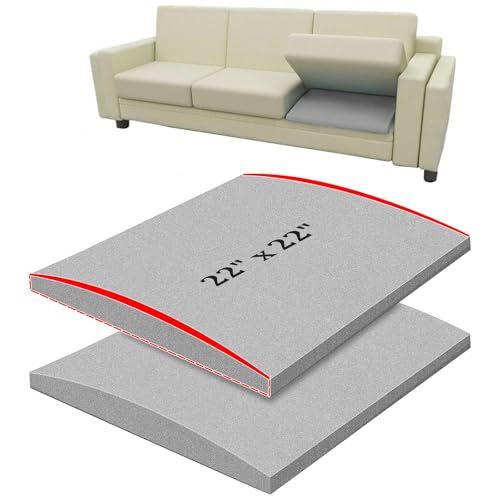
[Upgraded Large Size]: The sofa cushion support size is 22 " x 22", with a center arch thickness of 2.4 inches. Attention: Please measure the size of your sofa before purchasing to avoid purchasing the wrong size!

PROFESSIONAL GRADE - Whether you are replacing the worn out padding on a sofa, the sagging seat cushion on a chair, or just need an extra sleeping pad around the house, use the foam the pros use. This type foam is commonly found in high end pieces of furniture, and is the preferred choice by custom upholsterers. We have been selling our foam to professional furniture and bed makers for 34 years, and now it's available to you
When Do Sofas Go on Sale? Timing Your Purchase
Once you’ve settled on a durability budget of roughly $1,200 to $2,500 for quality cushions and solid joinery, you’ll want to align your purchase with predictable discount cycles rather than paying full freight. Major U.S. furniture sales cluster around four holidays: President’s Day, Memorial Day, Labor Day, and Black Friday. During these windows, retailers slash prices on floor models, discontinued fabrics, and outgoing silhouettes. You’ll often find deeper discounts baked into the sale itself, not just free shipping promotions.
For the best value, follow these timing strategies:
- Target late January through February clearance events for last year’s inventory.
- Shop end-of-season promotions in late summer and late winter for floor models.
- Prioritize big holiday weeks, when you can secure mid-range upholstery quality at a lower price without sacrificing casters, frame construction, or cushion density.

SECURE YOUR SECTIONAL WITH CONFIDENCE - The Couch Clamp PRO is your reliable solution for keeping sectional couch connectors securely attached, eliminating annoying gaps. Bid farewell to the frustration of slipping through sofa gaps with this easy-to-install 4-pack that ensures a seamless and sturdy connection for your couch and sofa. Transform your living space into a haven of stability with Couch Clamp PRO.

𝐂𝐇𝐄𝐂𝐊 𝐒𝐔𝐈𝐓𝐀𝐁𝐈𝐋𝐈𝐓𝐘 𝐁𝐄𝐅𝐎𝐑𝐄 𝐏𝐔𝐑𝐂𝐇𝐀𝐒𝐈𝐍𝐆: Confirm that there's ample space and a sturdy wooden frame at the bottom of the sofa to install the sofa snap sectional couch connectors. Ensure the sofa's bottom frame is at least 1 inch off the ground.

Material: Made of high quality plastic